Tax Credits
Disability Tax Credit Eligibility in 2026: What CRA Looks For
Check canada disability tax credit eligibility 2026 rules, CRA criteria, application steps, transfer options, and what to review before applying.

If you are checking canada disability tax credit eligibility 2026, start with the CRA test, not the dollar amount. The Disability Tax Credit, often called the DTC, is about whether a severe and prolonged impairment limits daily life in the way CRA defines it.
That sounds simple until you open the form. The strongest applications usually connect the medical restriction, its duration, and the way it affects basic activities of daily living.
| What you see | Likely cause | First move |
|---|---|---|
| You have a diagnosis but no approval yet | CRA does not approve based on diagnosis alone | Match the impairment to a CRA eligibility category |
| Your condition changes from day to day | CRA looks at the regular impact over time | Document how often the limitation affects daily activities |
| A child may qualify | The child may need extra support compared with a child of the same age | Ask the medical practitioner to describe the added care or supervision |
| You were denied before | The file may not have explained the limitation clearly enough | Read the denial reason before sending new information |
canada disability tax credit eligibility 2026: The Practical Test
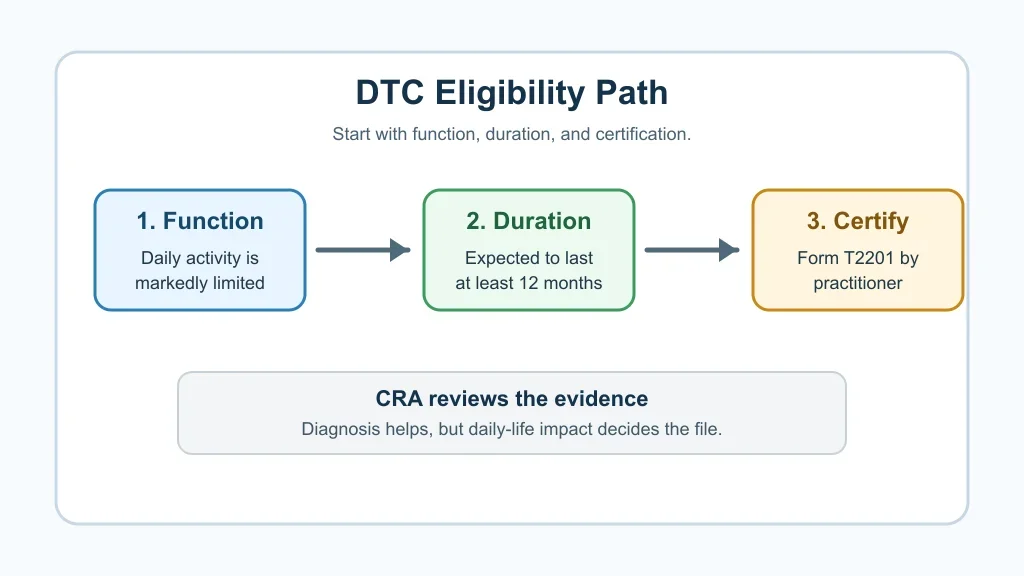
CRA looks for a severe and prolonged impairment in physical or mental functions. "Prolonged" generally means the impairment has lasted, or is expected to last, for a continuous period of at least 12 months.
"Severe" does not mean a person cannot do anything. It means the impairment markedly restricts a basic activity of daily living, takes an inordinate amount of time, or creates a comparable cumulative effect across activities.
Eligibility Areas CRA Reviews
Most DTC applications fall into one or more functional areas. CRA lists categories such as walking, feeding, dressing, speaking, hearing, vision, eliminating, mental functions necessary for everyday life, life-sustaining therapy, and cumulative effects of limitations.
Think about the gap between "I have a medical condition" and "this condition restricts daily function." That gap is where many applications succeed or fail.
- Marked restriction: The person is unable, or takes an inordinate amount of time, to perform a basic activity even with therapy, devices, and medication.
- Life-sustaining therapy: The person needs therapy to support a vital function, and the therapy meets CRA time and frequency rules.
- Cumulative effect: No single activity may qualify on its own, but the combined limits may create a marked restriction.
- Child supplement issues: A child may need substantially more help than another child of the same age.
How the 2026 Application Process Works
The DTC application is usually made with Form T2201. The person applying, or their legal representative, completes the personal section. A medical practitioner completes the section that matches the impairment.
CRA says the form can be submitted digitally or by paper. Online submission can be faster because the applicant can start the form and send the medical section to the practitioner electronically.
Do not send a stack of unrelated records just to look thorough. A focused file is better. CRA needs enough detail to decide whether the eligibility rules are met.
A Plain Way to Think About Your File
Start with one normal day. What can you do on your own? What takes far more time than it should? What do you avoid because it is too hard, too slow, or not safe?
Use plain words. You do not need to sound formal. You need to be clear.
For walking, note the distance, pace, aids, pain, stops, and rest time. For mental functions, note memory, judgment, focus, problem solving, and the support needed to get through basic tasks.
For therapy, track the time. Include setup, treatment, cleanup, and recovery if CRA says that time can count. Small details can matter when the rule is based on hours and days.
Keep a short list for the medical practitioner. Bring dates. Bring examples. Ask them to explain the limits in the part of the form that matches the condition.
That is the whole point of the DTC file. CRA is not just asking what health issue exists. CRA is asking how that issue changes daily life over time.
Keep notes as you go. Use dates. Use short facts. Say what changed. Say what help is needed. Say how long a task takes. Say what happens after the task. Pain, rest, risk, and missed tasks all help tell the story. Ask for plain notes from your care team. Keep each page clear. Do not guess. Do not pad the file. Give CRA the facts it needs.
What Approval Can Affect
DTC approval can let the person claim the disability amount on a tax return. If the person does not need the full amount to reduce their own tax payable, an unused amount may be transferable to a supporting family member when CRA rules are met.
DTC approval can also matter beyond the tax return. It may affect access to other federal disability-related programs, credits, or savings plans, depending on the program rules in force at the time.
If you are also tracking monthly support, keep the DTC separate from the Canada Disability Benefit payment dates and CPP Disability payment dates. Approval for one program does not automatically settle every other benefit question.
Common Reasons Applications Get Stuck
CRA can ask for more information if the form is vague, incomplete, or does not connect the medical facts to the eligibility category. Honestly, this is where people usually get tripped up.
A practitioner may describe the diagnosis carefully but skip the daily-life impact. Or the applicant may focus on income, stress, or unfairness, which may be real, but those points do not answer the DTC test.
- The form says "limited mobility" but does not explain distance, pace, aids, pain, or recovery time.
- The mental-functions section lists a condition but not the effect on judgment, memory, problem solving, or adaptive functioning.
- The application mentions treatment but does not show how often therapy is needed or how long it takes.
- The start date of impairment is unclear, which can affect past-year adjustment requests.
Related Benefit Guides to Check Next
Many DTC readers are also trying to separate tax credits, payment schedules, and household benefits. These guides can help you avoid mixing them up.
- Canada Disability Benefit payment dates
- provincial benefit payment dates
- GST/HST credit eligibility
- Canadian Dental Care Plan eligibility
- Ontario Trillium Benefit amounts
- tax refund or benefit payment
- when CRA recalculates benefits
- Ontario Trillium Benefit payment dates
- Canada Child Benefit increase in July
- Canada Child Benefit recalculation in July
- CRA benefits address change checklist
- Canada Child Benefit shared custody calculation
- Service Canada direct deposit
- CRA benefit overpayment repayment options
- CPP Disability payment dates
- CRA My Account benefit notice
- GIS Allowance payment dates
- Canada benefit overpayment notice
- BC Climate Action Tax Credit payment dates
- Alberta Child and Family Benefit payment dates
Quick Checklist
- Confirm the impairment is severe and prolonged under CRA wording.
- Choose the eligibility category that actually fits the daily limitation.
- Ask the right medical practitioner to complete the relevant section of Form T2201.
- Give clear dates for when the impairment began and whether it is expected to continue.
- Keep copies of the submitted form and any CRA letters.
- Review whether past tax years should be adjusted only after DTC approval.
- Update CRA if your address, marital status, or dependent situation changes. The CRA benefits address change checklist is useful for that.
Official Sources
Official sources: CRA DTC eligibility criteria · CRA how to apply for the DTC. Check current program pages before applying.
Frequently Asked Questions
who is eligible for disability tax credit in canada?
A person may be eligible if they have a severe and prolonged impairment that markedly restricts a basic activity of daily living, requires qualifying life-sustaining therapy, or creates a comparable cumulative effect. CRA makes the decision after reviewing the certified application.
does a diagnosis automatically qualify for the disability tax credit?
No. A diagnosis can support the application, but CRA focuses on how the impairment affects daily function and whether it meets the DTC criteria.
can i apply for the disability tax credit online?
Yes, CRA provides a digital application process for Form T2201, and a paper option is also available. The medical practitioner still needs to certify the relevant impairment section.
how long does disability tax credit approval last?
CRA may approve the DTC for a set period or indefinitely, depending on the medical information. Check the approval notice for the exact years covered.
can a family member claim the disability tax credit?
A supporting family member may be able to claim a transferred unused disability amount if CRA rules are met and the approved person does not need the full amount on their own return.
Bottom line: treat the DTC as an evidence-based eligibility file, not just a tax form. Start with CRA's criteria, make the daily-life impact clear, and keep the application focused.