Tax Credits
Tax Refund or Benefit Payment in Canada? How to Tell the Difference
Tax refund vs benefit payment Canada: learn how CRA refunds, credits, benefit dates, offsets, and notices differ before you call.

If a deposit from the CRA or the Government of Canada lands in your account, the phrase tax refund vs benefit payment Canada is a practical question, not just a search term. A refund usually follows an assessed tax return. A benefit payment usually follows an eligibility calculation, a benefit schedule, or a credit program.
Start with the notice behind the money. The bank description can be vague, but CRA My Account, your notice of assessment, and your benefit notices usually tell you why the payment was issued.
| What you see | Likely cause | First move |
|---|---|---|
| A one-time deposit after filing | Your return was assessed with a refund | Check the notice of assessment and refund status |
| A recurring monthly or quarterly deposit | A benefit or credit payment | Check benefit payment dates and notices |
| A smaller refund than expected | CRA kept part of it for an amount owing or government debt | Read the refund explanation in My Account |
| A benefit stopped after July | Annual recalculation or missing tax return information | Check your latest benefit notice and family details |
| Deposit went to an old account | Direct deposit or address information is out of date | Update CRA or Service Canada details before the next run |
Tax refund vs benefit payment Canada: the quick difference
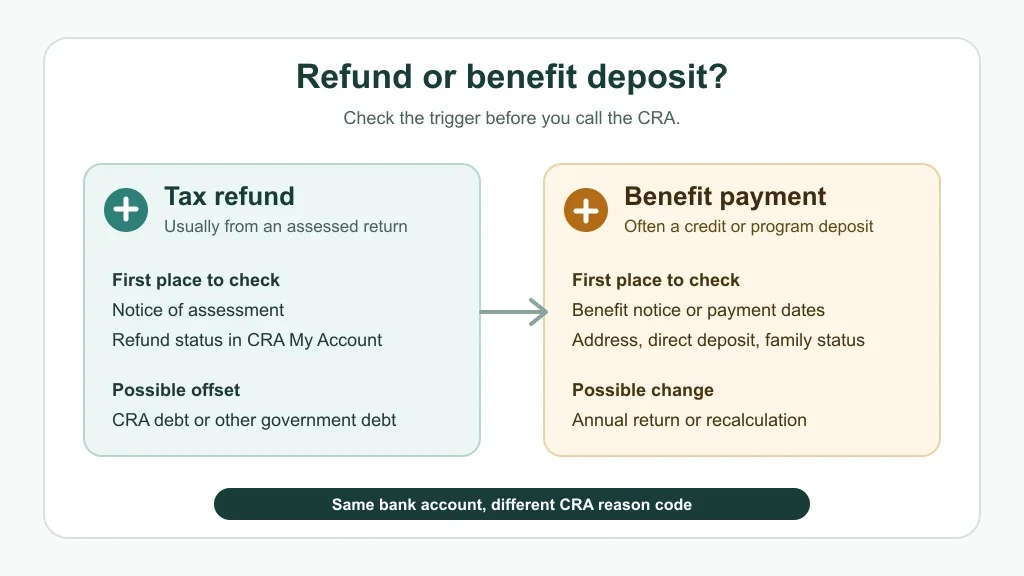
A tax refund is money returned after the CRA assesses your income tax and benefit return and finds that you paid more tax than you owed, or qualified for refundable credits through the return. It is usually tied to a specific tax year and notice of assessment.
A benefit payment is different. It can be a scheduled payment under a program such as the Canada child benefit, GST/HST credit-style payments, provincial credits, seniors benefits, or disability-related benefits. Some are administered by the CRA. Others come through Service Canada.
Why the same tax return can lead to two different payments
Your annual return does more than settle income tax. Canada.ca says you need to file every year to receive or keep receiving benefit and credit payments you are entitled to. That means one filing season can create a refund, update your benefit amounts, and trigger future credit payments.
Think of the return as the input file. The CRA uses income, marital status, children, province or territory, residency, and direct deposit details to calculate several outcomes. Some show up once. Others show up later.
For example, a parent may receive a tax refund in spring, then see benefit amounts change after the annual recalculation. If that is your situation, compare the refund notice with the guide to when the CRA recalculates benefits and the separate notes on the Canada Child Benefit recalculation in July 2026.
How to identify the deposit before you spend it
Open CRA My Account first. Look for the notice, benefit statement, or refund status entry that matches the deposit date. If the payment came from Service Canada, check that account or your latest correspondence instead.
Next, compare timing. Refunds are normally tied to return processing. Benefit payments follow program dates, which is why guides such as Ontario Trillium Benefit payment dates, CPP Disability payment dates, and GIS Allowance payment dates can help you separate tax-return money from scheduled support.
Finally, match the amount. Refunds often line up with your notice of assessment. Benefits may line up with a monthly, quarterly, or annual schedule, and the amount may change when your income, family status, province, or eligibility changes.
What if the refund is lower than expected?
Do not assume the CRA made a random change. Canada.ca explains that the CRA may keep all or part of a refund when there is an amount owing, a pending amount owing, certain government debts, outstanding GST/HST returns for a business, or a very small refund.
That can include benefit-related debt. If your notice mentions an overpayment, start with the plain-language guide to a Canada benefit overpayment notice, then look at CRA benefit overpayment repayment options before sending money or setting up a plan.
Honestly, this is where people usually get tripped up. A reduced refund is not the same thing as a cancelled benefit, but both can point back to the same account balance or family-status update.
What if the benefit amount changed?
Benefit payments can change after a new tax return, a July recalculation, a marital-status update, a child custody change, a move, or a program rule update. For family benefits, review the Canada Child Benefit increase in July 2026 notes and the shared custody CCB calculation guide if your household arrangement changed.
For newer or renamed credits, watch the program page and your CRA notice instead of relying on a bank memo. If you are comparing grocery-style credits, read the explainer on GST/HST credit and CGEB changes, then check CGEB eligibility in 2026 and Canada Groceries and Essentials Benefit amounts.
Province-specific credits add another layer. A benefit deposit could be tied to a province or territory rather than your federal refund, so compare it with pages such as BC Climate Action Tax Credit payment dates or Alberta Child and Family Benefit payment dates when the amount does not match a federal schedule.
When direct deposit, address, or account details are the real issue
A correct calculation can still go sideways if your account details are old. Update your CRA address, direct deposit, and family information before the next expected payment date, especially after a move, separation, new child, custody change, or bank switch.
Use the checklist to update your CRA benefits address if notices are not arriving. If the payment is from Service Canada, review Service Canada direct deposit setup as well.
Need to trace a missing benefit? Start with check CRA benefit payments. For parents, the focused guide on Canada Child Benefit not received is the better next stop.
Special cases that can blur the line
Newcomers, students, seniors, people with disabilities, and families with changing custody arrangements may see several CRA or Service Canada decisions close together. A refund, a credit, and a benefit adjustment can all happen in the same season.
For disability-related support, keep tax credits and benefit eligibility separate in your notes. A disability tax credit decision can affect tax calculations, while a payment program has its own eligibility path. Start with the Canada Disability Benefit eligibility guide when you need to verify program rules.
One practical habit helps: write down the date, amount, program name, and notice source for every payment. You do not need a spreadsheet masterpiece. You just need enough detail to avoid mixing a refund with a scheduled benefit.
Quick Checklist
- Check whether the payment matches a notice of assessment, benefit notice, or Service Canada letter.
- Compare the deposit date with the refund status page or the relevant benefit payment calendar.
- Look for offsets, overpayments, or government debts if the refund is smaller than expected.
- Confirm your direct deposit, mailing address, marital status, and child information.
- File your tax return every year if you want benefit and credit payments to continue.
- Keep screenshots or PDFs of notices before calling CRA or Service Canada.
- Use official pages first when the amount, date, or eligibility rule affects your budget.
Bottom line: a tax refund and a benefit payment can arrive through the same banking setup, but they come from different decisions. Match the deposit to the notice first, then follow the right path. That one step can save you a frustrating call and help you avoid spending money that may later be adjusted.
Frequently Asked Questions
Is a CRA tax refund the same as a benefit payment?
No. A tax refund usually comes from an assessed tax return. A benefit payment usually comes from a benefit or credit program, even when your tax return information helps calculate it.
Why did CRA take part of my refund?
The CRA may keep all or part of a refund if you owe money, have a pending amount owing, have certain government debts, have specific outstanding business GST/HST returns, or are owed a very small refund.
Do I need to file taxes to get Canada benefit payments?
In most cases, yes. Canada.ca says you need to file your taxes every year to receive or continue receiving benefit and credit payments you are entitled to.
How do I know what a CRA deposit is for?
Check CRA My Account, your notice of assessment, your benefit notices, and the payment date. If the money came from Service Canada, check your Service Canada account or latest letter.
Can a benefit overpayment reduce my tax refund?
Yes, it can. If your CRA account shows a benefit overpayment or other amount owing, part of a refund may be kept and applied to that balance.
What should I check if my benefit payment is missing?
Confirm the payment date, direct deposit details, address, latest tax return, marital status, and program notice. Then contact the CRA or Service Canada only after the official wait period or program guidance says to follow up.
Official sources: Tax credits and benefits for individuals - Canada.ca · Tax refunds - Canada.ca.