Families
Canada Child Benefit Shared Custody Calculation in 2026
canada child benefit shared custody calculation 2026: learn CRA 40% to 60% custody rules, 50% payment split, and July updates.

If you are searching for canada child benefit shared custody calculation 2026, the short answer is that the CRA does not split the Canada Child Benefit by your exact parenting-time percentage. If the CRA treats the arrangement as shared custody, each eligible parent gets 50% of the amount they would receive if the child lived with them full time, and each parent's amount is calculated using that parent's own adjusted family net income.
That detail matters. A 50/50 parenting schedule, a 4-days-and-3-days schedule, and some other near-equal rotations can all land in the same CRA shared-custody bucket, but the two parents may still receive different dollar amounts because their incomes and family situations are different.
| What you see | Likely cause | First move |
|---|---|---|
| One parent receives the full CCB | The CRA may not have processed shared custody for both parents yet | Check CRA My Account and update the custody arrangement |
| Both parents receive different CCB amounts | Each parent is assessed on their own adjusted family net income | Compare notices, not just monthly deposits |
| A 60/40 schedule is not split 60/40 | CRA shared custody uses a 50% payment rule once the arrangement qualifies | Confirm whether the child lives with each parent 40% to 60% of the time |
| Your July 2026 payment changes | CCB payments are recalculated every July using the previous year's income | Review the new benefit notice after your 2025 tax return is assessed |
How the shared custody CCB calculation works
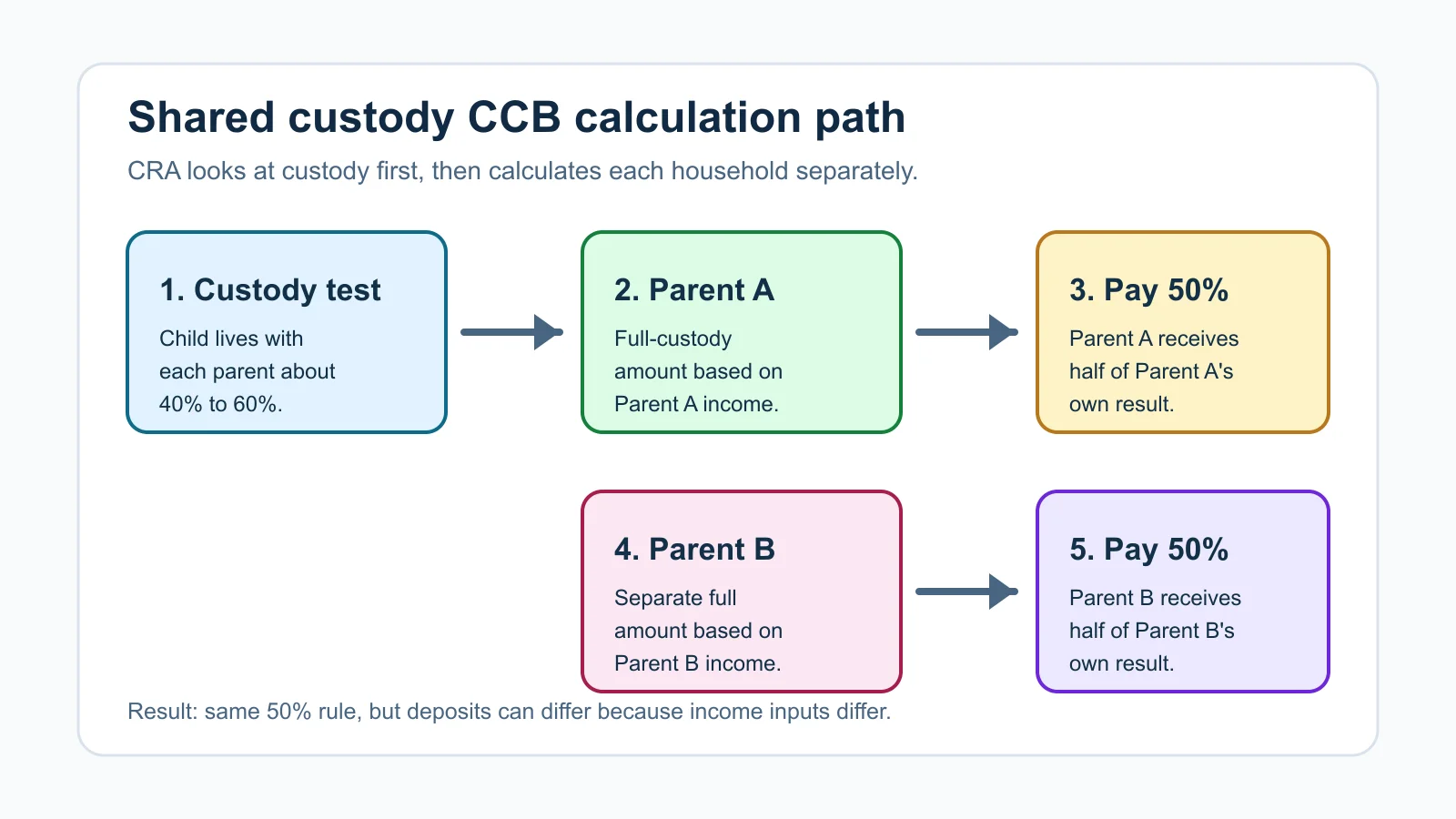
Start with the custody test. CRA guidance says shared custody generally applies when a child lives with each parent 40% to 60% of the time, usually at different addresses, on a more or less equal basis. Common examples include alternating weeks or a weekly 4-and-3-day rotation.
After that, the benefit math is not a parenting-time fraction. CRA first works out what Parent A would receive if the child lived with Parent A all the time. Parent A gets 50% of that amount. CRA then does the same separate calculation for Parent B, using Parent B's adjusted family net income.
Why 2026 has two benefit-year pieces
Think of 2026 in two parts. Payments from January to June 2026 fall inside the July 2025 to June 2026 benefit year, which CRA says is based on adjusted family net income from 2024.
Payments from July to December 2026 fall into the next benefit year. CRA recalculates CCB payments every July, so the July 2026 notice should reflect the income information from 2025 after tax returns are processed.
That is why a parent can see a change in July even if the parenting schedule did not change. Income, marital status, number of eligible children, child age, and provincial or territorial supplements can all affect the notice.
What counts as shared custody for CRA purposes
Shared custody is not just a phrase in a parenting plan. For CCB purposes, the CRA looks at where the child actually lives and who is primarily responsible for care and upbringing when the child is in that home.
A child living with one parent every second weekend is usually below the 40% threshold, so that parent normally would not be eligible for CCB for that child. A child living mostly with one parent, more than 60% of the time, points toward full custody for the parent with the larger share.
Real life can be messier than a calendar. CRA materials acknowledge that illness or summer vacation can temporarily make one month look like 38% and 62%, so the pattern and the explanation matter when the arrangement is otherwise shared.
Example: why the two parents may not receive the same amount
Say Parent A and Parent B have a qualifying shared-custody arrangement for one child. Parent A has a lower adjusted family net income, while Parent B has a higher adjusted family net income.
CRA does not calculate one combined CCB amount and cut it in half. Instead, Parent A gets 50% of Parent A's own full-custody calculation, and Parent B gets 50% of Parent B's own full-custody calculation. Because the income inputs differ, the deposits can differ too.
Honestly, this is where many families get tripped up. They expect equal custody to mean equal cheques, but the CRA formula is built around each parent's separate benefit entitlement.
What to update before relying on the number
Use CRA My Account or the child benefits application process when shared custody starts, ends, or changes. If one parent keeps receiving 100% because the other parent has not applied or the shared arrangement has not been reported, CRA materials warn that retroactive repayment can happen once the other parent's entitlement is recognized.
Also check basic payment setup. A changed separation status, new address, different direct deposit account, or late tax return can all create noise around the payment, even when the custody calculation itself is correct. For payment logistics, see our guide to setting up direct deposit for Service Canada benefits and what to do when a Canada Child Benefit payment is not received.
If CRA later says you were overpaid, do not guess at the balance. Start with the notice, then compare the months involved against the custody dates and the benefit-year income used. Our guides on repaying a CRA benefit overpayment, a Canada benefit overpayment notice, and a CRA My Account benefit notice walk through that paper trail.
How to estimate your 2026 payment without overclaiming certainty
Use the 50% shared-custody rule as the last step, not the first. First estimate the full-custody CCB entitlement for that parent using the relevant benefit year, the parent's adjusted family net income, the child's age, and any other family details that apply. Then halve that parent's result if the arrangement qualifies as shared custody.
For January to June 2026, check the current CRA notice tied to the July 2025 to June 2026 benefit year. For July 2026 onward, wait for the updated CRA notice after the annual recalculation, especially if 2025 income changed or a child moved into a new age bracket.
Need a broader amount walkthrough? Read our plain-language guide to estimating the Canada Child Benefit amount. Related household credits can also change your cash-flow planning, including the GST credit amount, the GST/HST credit and CGEB change, CGEB eligibility in 2026, and Canada Groceries and Essentials Benefit amounts.
Related benefit guides
Family benefit planning often overlaps with other CRA and Service Canada notices. These related guides may help if you are reviewing several payments at the same time:
- setting up direct deposit for Service Canada benefits
- repaying a CRA benefit overpayment
- CPP Disability payment dates for 2026
- checking a CRA My Account benefit notice
- GIS Allowance payment dates
- reading a Canada benefit overpayment notice
- BC Climate Action Tax Credit dates
- Alberta Child and Family Benefit dates
- the GST/HST credit and CGEB change
- CGEB eligibility in 2026
- what to check if your Canada Child Benefit is not received
- Canada Groceries and Essentials Benefit amounts
- Canada Disability Benefit eligibility
- checking CRA benefit payments
- CRA benefit payment checks before calling
- estimating the GST credit amount
- estimating the Canada Child Benefit amount
- GIS payment dates
- OAS payment dates
- CPP payment dates
Quick Checklist
- Confirm whether the child lives with each parent about 40% to 60% of the time.
- Check that both eligible parents have applied or updated the custody arrangement with CRA.
- Estimate each parent's full-custody CCB amount separately before applying the 50% rule.
- Use the correct benefit year: January to June 2026 is not the same calculation period as July to December 2026.
- Review CRA My Account notices after separation, custody, income, address, or banking changes.
- Keep a simple custody calendar in case CRA asks for support.
- Do not assume equal parenting time means equal dollar deposits.
Official Sources
Official sources: CRA: How much you can get from the Canada child benefit | CRA guide T4114: Canada Child Benefit.
Frequently Asked Questions
How does CRA calculate CCB for shared custody?
CRA calculates what each parent would receive if the child lived with that parent full time, using that parent's own adjusted family net income. If the arrangement qualifies as shared custody, each parent gets 50% of that personal full-custody entitlement.
Is Canada Child Benefit split 50 50 in shared custody?
Yes, if CRA considers the arrangement shared custody, but the result is often misunderstood. The 50% applies to each parent's own entitlement, so the two parents may receive different dollar amounts.
What is the 40 60 rule for CCB shared custody?
CRA generally treats a child as being in shared custody when the child lives with each parent 40% to 60% of the time on a more or less equal basis, usually at different addresses. Below 40%, the parent normally is not eligible for that child's CCB.
Why did my CCB shared custody amount change in July 2026?
CCB payments are recalculated every July. A July 2026 change may reflect 2025 adjusted family net income, a new child age category, updated family status, or a custody update that CRA processed.
Can one parent get 100% of CCB in shared custody?
If CRA recognizes shared custody, it says it will not give the full amount to one parent or split the amount by another percentage. If one parent previously received 100%, CRA may later adjust the account when the other parent applies.
Shared-custody CCB math is less about negotiating a percentage and more about getting the CRA record right. Confirm the custody pattern, check the benefit-year notice, and treat the 50% rule as a separate calculation for each household.