Federal Benefits
Set Up Direct Deposit for Service Canada Benefits
service canada direct deposit benefits setup explained: banking numbers, Service Canada vs CRA updates, joint accounts, and payment checks.

If you are trying to arrange service canada direct deposit benefits, start by matching the payment to the department that actually sends it. Service Canada can handle direct deposit for Employment Insurance, Canada Pension Plan, Old Age Security, and some other ESDC payments, while CRA benefits use a separate CRA direct deposit setup.
Direct deposit is usually the cleanest way to receive federal payments, but the details matter. A wrong transit number, an old joint account, or an assumption that one update covers every department can leave you waiting for money that should already be on its way.
| What you see | Likely cause | First move |
|---|---|---|
| You still receive cheques | The direct deposit change has not reached the paying department or the next payment was already processing | Check the department that pays that specific benefit |
| CPP, OAS, or EI goes to an old account | Service Canada may still have old banking details | Update the Service Canada record and keep proof of the request |
| CRA credits are correct but Service Canada benefits are not | CRA and Service Canada can require separate updates | Do not assume CRA My Account changed ESDC payments |
| A bank closed or merged your account | Your branch, institution, or account number may have changed | Get a fresh void cheque or direct deposit form from the bank |
| You manage payments for someone else | Power of attorney or trustee paperwork may be needed | Confirm authority with each department before changing banking |
What You Need Before You Start
Estimated time: 10 to 15 minutes. Get the banking details from the account where the benefit should land. Use a void cheque, an electronic direct deposit form from online banking, or written details from the financial institution.
- Write down the recipient's Social Insurance Number and the name used on the benefit account.
- Confirm the financial institution name, branch or transit number, institution number, and account number.
- Check whether the account is personal or joint. Joint accounts can be used for government direct deposit, but the account should be in the name of each person receiving payments.
- List every benefit you receive, such as EI, CPP, CPP disability, OAS, GIS, or CRA-administered credits, before changing anything.
How Service Canada direct deposit benefits work
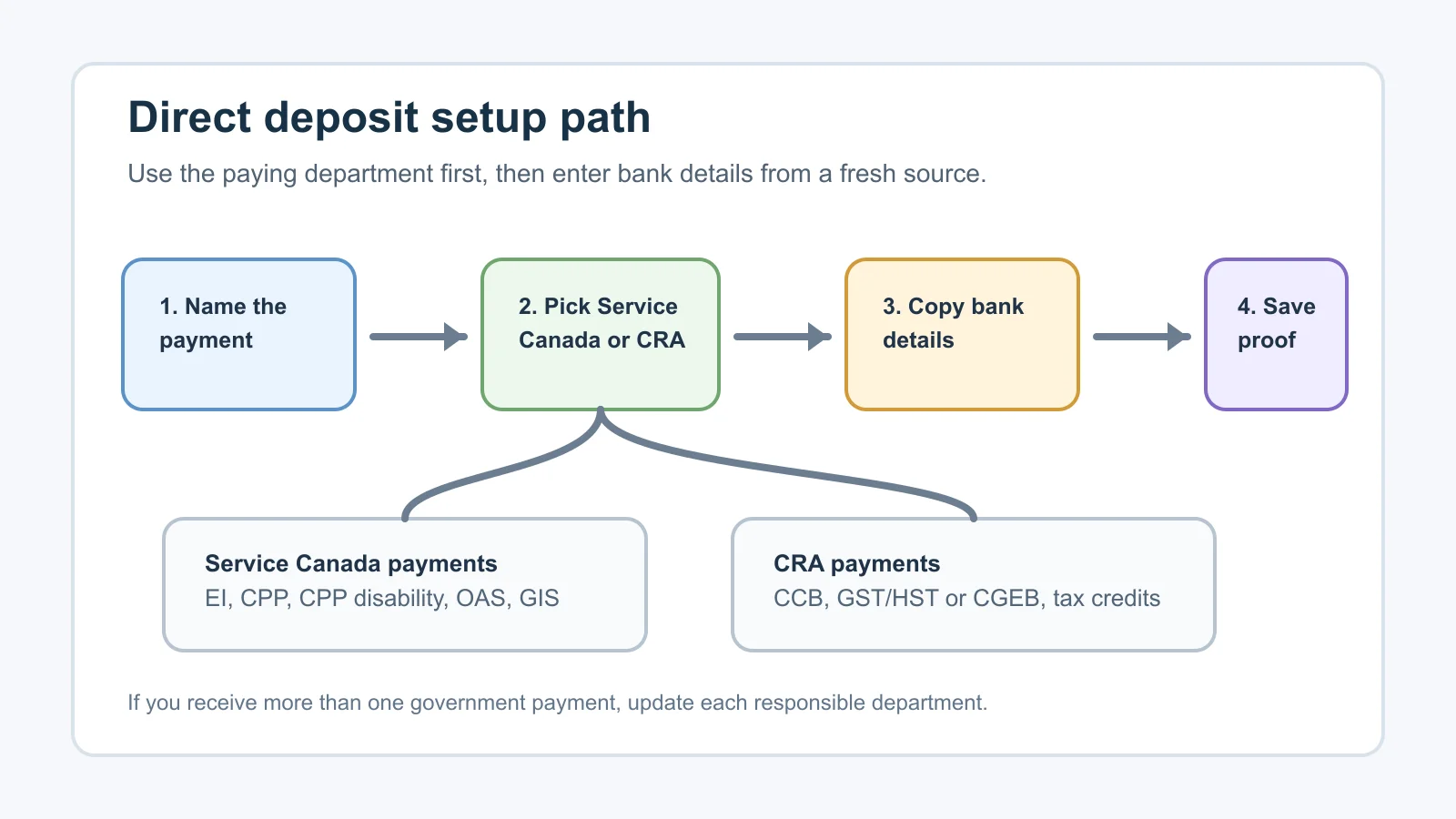
Estimated time: 5 minutes to sort the payment type. Service Canada is the front door for many Employment and Social Development Canada payments. CRA credits and tax refunds sit on the CRA side, so one banking update may not cover everything in your household.
- Put Service Canada payments in one group: EI, CPP, CPP disability, OAS, GIS, and ESDC program payments.
- Put CRA-administered benefits in another group: Canada Child Benefit, GST/HST credit or CGEB, Canada Workers Benefit, tax refunds, and many provincial credits paid through CRA.
- If you are checking retirement or disability cash flow, compare the direct deposit change with payment timing guides such as CPP Payment Dates 2026, CPP Disability Payment Dates 2026, OAS Payment Dates 2026, GIS Payment Dates 2026, and GIS Allowance Payment Dates 2026.
Keep the categories separate even if the payments arrive in the same bank account. A Service Canada update should not be treated as proof that your CRA benefits are also updated.
Step 1: Confirm Which Office Pays the Benefit
Estimated time: 10 minutes. Start with the payment name, not the bank account. Government payment names can look similar on a statement, and a wrong assumption sends you to the wrong support channel.
- Open the most recent notice, payment stub, or online account entry for the benefit.
- Look for the department name: Service Canada, Employment and Social Development Canada, Canada Revenue Agency, Veterans Affairs Canada, or another agency.
- If a payment is late or looks wrong, contact the department responsible for that payment rather than your bank first.
For CRA-side payments, use CRA-specific checks instead. Helpful starting points include how to check CRA benefit payments, CRA My Account benefit notice, CRA benefits payment not received, and Canada Child Benefit not received.
Step 2: Read Your Banking Details Carefully
Estimated time: 10 minutes. The numbers at the bottom of a cheque are not all used for direct deposit. Canada.ca explains that the cheque number is not required, while the branch, institution, and account numbers are required.
- Use the branch or transit number, usually five digits.
- Use the institution number, usually three digits.
- Use the account number exactly as your bank gives it, including leading zeroes if the form shows them.
- Skip the cheque number unless the official form separately asks for it.
- If you do not have a cheque, download an electronic void cheque or ask the bank for direct deposit details.
Do not copy numbers from memory. Honestly, this is where small mistakes become payment delays. A fresh bank document is faster than trying to fix a rejected deposit later.
Step 3: Update Service Canada or Use the Right Direct Deposit Path
Estimated time: 15 to 30 minutes. Use the official Service Canada direct deposit page or the direct deposit path for the specific ESDC program. Some programs can be handled online, while others may point you to a phone, mail, application, or Service Canada office route.
- For Service Canada benefits, start from the official Canada.ca Service Canada direct deposit page.
- Choose the option for individuals in Canada or outside Canada if the page asks.
- Enter the banking information from the document you just checked.
- If you are applying for a specific ESDC program, check whether the application itself includes the direct deposit step.
- If the benefit belongs to CRA, update CRA direct deposit instead and review related CRA amount guides such as GST credit amount 2026, Canada Child Benefit amount 2026, Canada Groceries and Essentials Benefit amounts for 2026, and CGEB Eligibility in 2026.
Pause before closing an old account. Wait until the first payment lands in the new account, especially if rent, groceries, or medication costs depend on that deposit.
Step 4: Check the First Payment After the Change
Estimated time: 5 minutes on payment day, then follow up if needed. A banking change can miss the next scheduled deposit if the payment was already in process. That does not always mean the update failed.
- Check the expected payment date for the program.
- Look in the new account first, then the old account if it is still open.
- If a cheque arrives, keep it and verify whether the direct deposit change was too late for that cycle.
- Contact the responsible department if you keep receiving cheques or the amount is missing, incorrect, or unexpected.
For broader timing checks, use the Canada Benefit Payment Dates 2026 calendar. Provincial and program changes can have their own timing, including Alberta Child and Family Benefit Payment Dates 2026, BC Climate Action Tax Credit Payment Dates 2026, and the CRA transition note in GST/HST Credit Replaced by CGEB in 2026.
Step 5: Protect Yourself From Wrong-Payment Problems
Estimated time: 10 minutes now, more if a notice needs action. Direct deposit does not fix eligibility, overpayment, or notice issues. It only changes where the money is sent.
- Read any new notice before assuming a smaller payment is a banking problem.
- If a benefit is reduced or redirected, check whether there is an overpayment balance or recovery action.
- Use official account pages and phone numbers from Canada.ca or the notice, not links from texts, emails, or ads.
- If disability, family, or grocery-benefit eligibility is part of the issue, review the program rules before calling.
Direct deposit confusion can overlap with overpayments and eligibility. Related checks include Canada benefit overpayment notice, CRA benefit overpayment repayment options, Canada Disability Benefit 2026 eligibility, and GST/HST Credit Replaced by CGEB in 2026.
Quick Checklist
- Identify the exact benefit and the department that pays it.
- Use a fresh void cheque, electronic direct deposit form, or bank-provided account details.
- Enter the branch or transit number, institution number, and account number carefully.
- Update Service Canada and CRA separately when both departments pay you.
- Keep the old account open until the first new deposit arrives, if possible.
- Save confirmation details from any online change.
- Call the responsible department if cheques continue or the payment is late, unexpected, or incorrect.
What to Remember
Setting up direct deposit for Service Canada benefits is mostly a matching exercise: right department, right account, right payment. Once those pieces line up, the process is usually straightforward.
Be careful with mixed households, joint accounts, and people who receive both Service Canada and CRA payments. The fastest fix is often not another form, but figuring out which payment record actually needs the change.
Official sources: Service Canada direct deposit and Canada.ca direct deposit guidance. Check the official page for the current route before changing banking information.
Frequently Asked Questions
how do i set up direct deposit for service canada benefits?
Start from the official Service Canada direct deposit page, choose the route that fits your situation, and enter the banking details from a void cheque, online banking direct deposit form, or your financial institution. Keep confirmation details after you submit the change.
does service canada direct deposit update cra benefits too?
Not necessarily. Canada.ca says people receiving multiple government payments may need to contact more than one department. Service Canada and CRA payments should be checked separately.
what banking numbers do i need for service canada direct deposit?
You generally need the financial institution name, branch or transit number, institution number, and account number. Service Canada also lists your Social Insurance Number among the information needed to set up or change direct deposit.
can service canada benefits go into a joint account?
Canada.ca says government direct deposit payments can go into a joint account, but the account should be in the names of each person receiving payments from the government.
why am i still getting cheques after setting up direct deposit?
The change may have missed the next payment cycle, gone to the wrong department, or failed because the banking details were incorrect. Contact the department responsible for that payment if cheques continue.
should i close my old bank account right away?
No. If possible, keep the old account open until you see the first Service Canada payment land in the new account. That gives you a backup if the next payment was already processing.